
Many moons ago, again while making a trip to the local library, I picked up a tome that only marginally interested me. It was written by a former UCLA bench-warmer who wanted to celebrate his former coach, John Wooden. If you want to know more about Coach Wooden, Google it. Just know that he is perhaps the most successful college basketball coach to have ever roamed the sidelines.
This book was the first time that I was introduced to Coach Wooden’s “Pyramid of Success”.
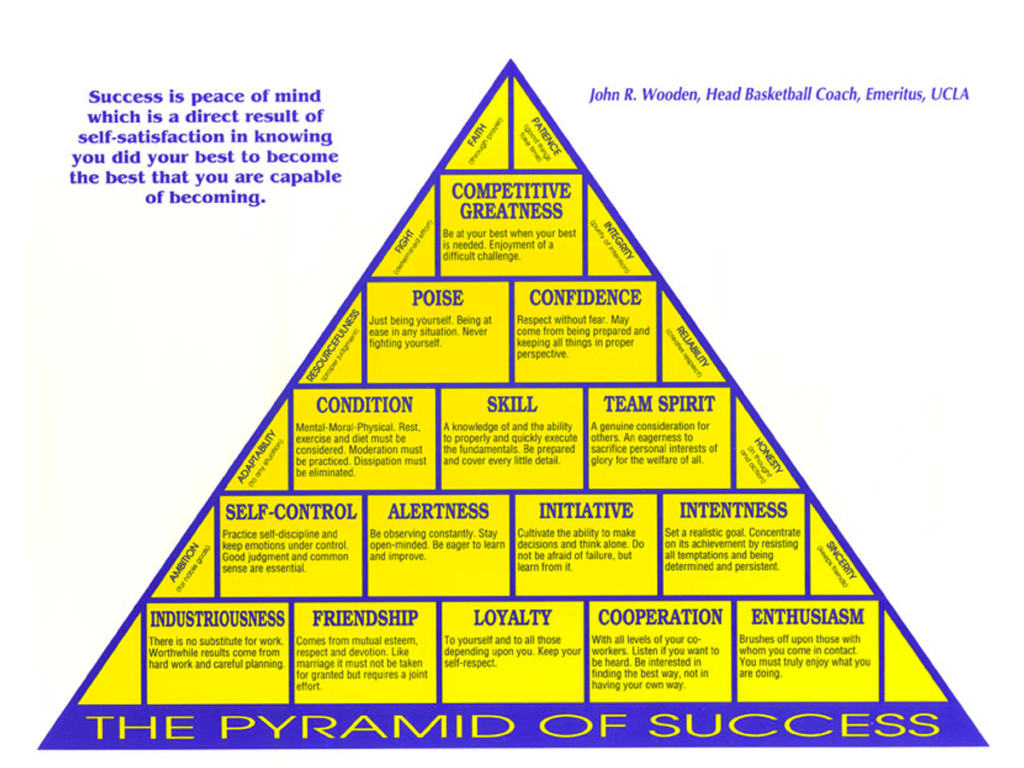
He created this pyramid much like Maslow’s Hierarchy of Needs. The bottom layer includes traits that must be satisfied prior to being able to satisfy the next layer and so on. In coach Wooden’s eyes, the only way to be a perennially successful team was to climb through all five levels of his pyramid of success. By the time the author wrote this book, Coach Wooden was a frail, dying old man. Nevertheless, the wisdom that he imparted to his athletes, and by extension to us, is in my opinion, timeless.
One of the greatest lessons I learned from Coach Wooden, through this book, is that you cannot treat people equally in order to be successful. While some will grumble that others are divas and that they shouldn’t be given preferential treatment, what those who complained did not understand was that Coach was also treating them unequally, according to their temperaments and gifts. In order to create a powerful team, you need to meet people where they are. Often this means forgiving the occasional transgression in order to magnify their own, special giftedness. It won’t make you popular with everyone at the moment, but as the cliche states, success breeds success.
I am thankful to have learned this lesson, and despite my own desires for the concept of “parity”, as I’ve practiced Coach Wooden’s missives, I have found that teams are stronger, more performant, and happier for it (even if they grumble a bit).